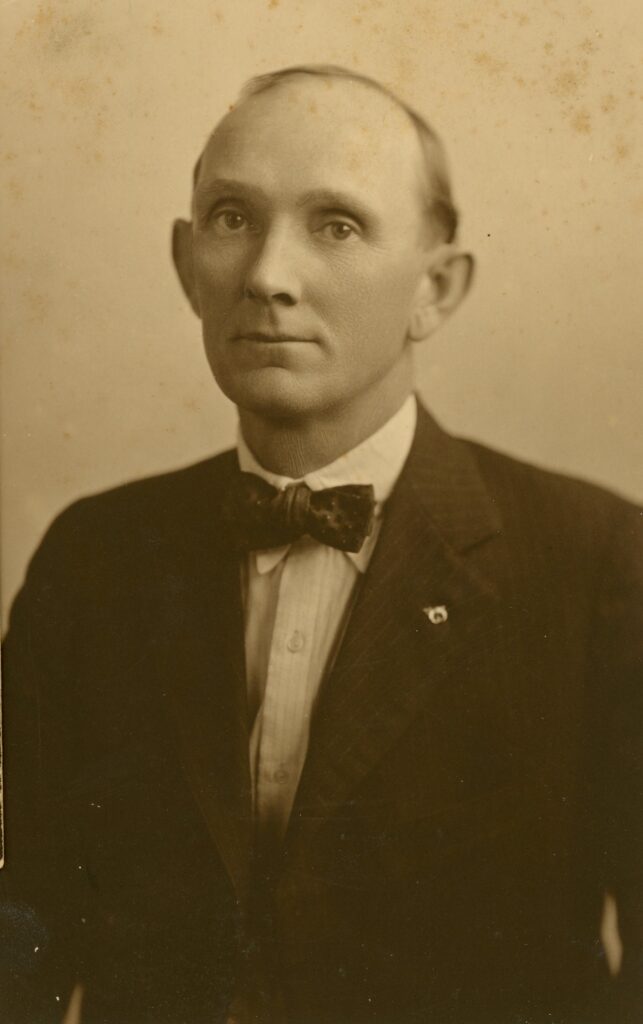
While countless drivers travel down Lewis Street in Downtown Kennesaw each day, few realize who the road is named after. A century ago, he was one of the most important individuals in our community.
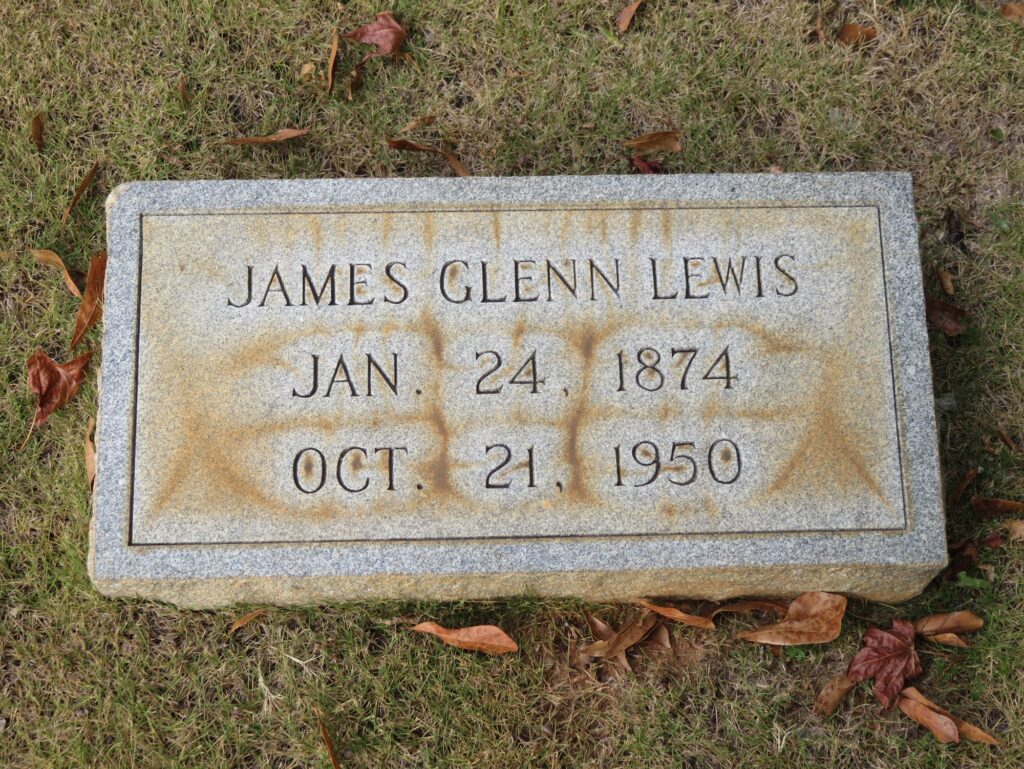
James Glenn Lewis, who went by Glenn, was born near Lost Mountain on January 24, 1874. Lewis had an early love of baseball and according to a family history played as much as he could when growing up (except on Sundays). At the age of eighteen, he began working for his uncle, Henry Roberts, at a sawmill.
Lewis moved to Kennesaw in early 1900 to become a merchant. He first worked in the Hill Building at what is now the corner of Main Street and J. O. Stephenson Avenue. There was some expectation that Henry Roberts would join him, but only Lewis came to our town. When he moved here, Lewis purchased a house built in 1889 by James Stanley, and it would remain Lewis’s home for the rest of his life. The home still stands on Dallas Street, in the Park at Main development. Within a year of moving to Kennesaw, he married Simmie Eidson, who, according to the January 31, 1901, Marietta Journal, was “one of our prettiest young ladies and possessed with all the accomplishments that make women lovely.” Around this same time, Lewis became involved with the local Masonic Lodge.
In 1903, Lewis started constructing a two-story brick store for the corner of present-day Main and Lewis Streets. The first floor of the building would house Lewis’s mercantile store, while the second story would become the new Masonic Hall. Partway through construction, the decision was made to add another story for the store, creating the current three-story structure. The building was completed in 1904. Inside his store, Lewis sold everything from dry goods to underwear. The store stayed open in that same location until 1921. A 1913 catalog from the store is now in the collection of the Kennesaw State University Archives.
In 1908, Lewis built a cotton gin across the railroad tracks, which became a hub for local farmers. In the basement of the building was a generator that provided electric power to area homes. In an accident at the gin, Lewis lost his right hand, while his left hand was permanently damaged by a sawmill on another occasion. The cotton gin burned to the ground in 1943 and was rebuilt by Mr. Lewis. Eventually purchased by Steve Frey, the gin was later donated to the City of Kennesaw to house the General. The original gin building still houses the locomotive, though the museum has been significantly expanded.
The same year Lewis built his cotton gin, he became involved with the Bank of Kennesaw as its Vice President. The bank went through some difficulty in its early years and was reformed in 1910 as the Kennesaw State Bank. Lewis was involved with this enterprise as well. The bank was located in the building next to Lewis’ store. His daughter, Mildred, was the bank’s final president when it closed in 1951.
In 1907, Lewis was elected mayor of Kennesaw. He served until 1910, was reelected for a one-year term in 1915, and served again from 1926 to 1929. Despite his long service as mayor, there is no record of him serving as a member of the City Council.
As the automobile gained traction, Lewis started a Ford dealership in partnership with D. P. Butler. An ad for the dealership from the May 24, 1912, Marietta Journal and Courier encourages the consumer to “’Ford-i-fy’ yourself against excessive automobile expense” and includes prices for the Model T, with the cheapest being a two-passenger version available for $590. Adjusted for inflation, this is around $20,000 today. After several years, Lewis parted ways with Butler and the Ford brand and became involved with an Atlanta firm called the Southern Saxon Company that sold Saxon and Chandler vehicles. By 1917, he had become president of the company. Lewis had dealerships in Rome, Birmingham, and Jacksonville and began selling Stanley Steamers.
Though he grew up in a religious household, Lewis did not join a Kennesaw church until around 1940. The pastor at the Methodist Church at the time, Charles Allen, was an excellent checkers player and, according to the Lewis family history, used this skill to convince Glenn Lewis to join his church.
The Great Depression caused Lewis to fall into debt, and he returned to Kennesaw. In 1931, he sold his building downtown and was able to pay off all of his debts. He suffered a stroke in 1947 and was in poor health for the rest of his life. James Glenn Lewis passed away on October 21, 1950.
The article above by Andrew J. Bramlett was first published in Around Kennesaw magazine in October 2023.